Nearshoring has evolved. What once served primarily as a cost arbitrage tactic has become a central piece of how enterprises access talent for AI, cloud, cybersecurity, and digital transformation initiatives. Proximity still matters, but in 2026, the real economic pressure doesn’t come from geography; it comes from competition for adaptive digital capability. Traditional recruitment models - post a job, screen candidates, onboard - are proving slow, costly, and inefficient in this environment.
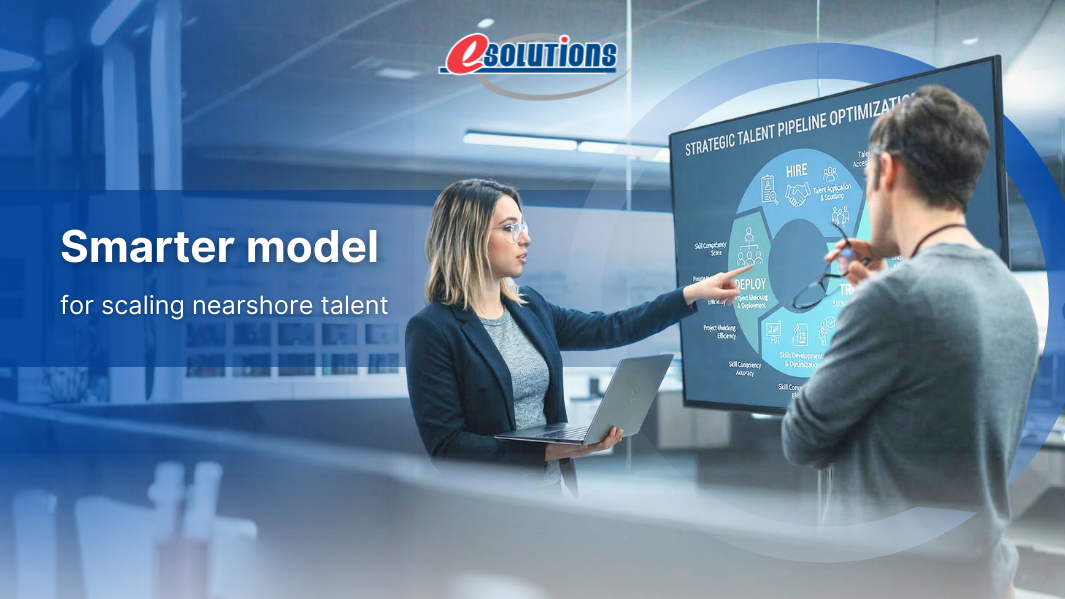
The Hire-Train-Deploy (HTD) model is an approach that reorients workforce strategy from transactional hiring toward predictable capability creation. HTD doesn’t just find talent; it builds it, aligns it to enterprise needs, and deploys it rapidly into value-creating workstreams. For IT staffing partners and enterprise clients alike, HTD is becoming a strategic necessity, not an optional supplement.
The Cost Problem in Nearshore Talent Acquisition
The financial burden of hiring remains stubbornly high. According to the Society for Human Resource Management (SHRM), the average cost per hire is nearly $4,700 - and that figure rises above $15,000 when training and lost productivity are factored in.
For tech-driven organizations operating in nearshore markets, this expense compounds quickly. Projects demand niche skills that are rarely abundant, meaning companies often pay premiums to secure talent that meets yesterday’s requirements - even as those requirements change daily with cloud migrations, AI integrations, and cross-platform refactors.
Adding to this, companies face high hidden costs:
- A mismatched hire can cost up to 30% of that person’s annual salary to replace.
- Training budgets in traditional settings average $1,286 per employee annually, yet still do not guarantee job-ready capability.
- Time-to-productivity for new graduates often spans three to six months, a delay that can derail project timelines and client commitments.
These realities expose a core flaw: reactive hiring fills seats but does not reliably produce capability.
How Hire-Train-Deploy Reshapes Nearshore Talent Economics
The HTD model transforms this dynamic by engineering workforce readiness rather than buying it. Instead of competing head-to-head for fully formed specialists and driving up compensation costs, HTD builds talent within a structured pipeline that fulfills both technical skill requirements and cultural integration expectations.
1. Reduced Hiring Costs
By outsourcing sourcing and initial training to a build-ready pipeline, companies reduce dependency on costly agency fees and prolonged market searches. As demonstrated in real-world applications, organizations that implement HTD have reported up to a 40% reduction in overall hiring costs compared with traditional recruitment processes.
Instead of paying premiums for scarcity, enterprises invest in targeted skill development that precisely aligns with their tools, processes, and delivery cultures, paying only when candidates are ready to contribute.
2. Lower Attrition and Replacement Costs
One of the most significant hidden costs in recruitment is employee turnover. An employee who leaves early forces teams into another expensive search, and the costs of replacement quickly add up. The HTD model addresses this by ensuring candidates are trained and a good fit before deployment, resulting in up to a 25% reduction in attrition compared to traditional hiring methods.
This boost in retention isn’t accidental; it’s built into the system. Candidates trained with enterprise context arrive prepared, feel more confident in their roles, and see clearer growth pathways within client organizations.
3. Faster Time-to-Productivity
In knowledge-work settings, the difference between a new hire contributing in weeks versus months can be transformational. HTD accelerates readiness through pre-deployment training, enabling new professionals to begin delivering measurable value in a fraction of the time traditional methods require. Companies leveraging HTD report onboarding time reduced by up to 60%.
This acceleration impacts more than cost; it directly influences project velocity, an increasingly decisive metric in nearshore delivery where agility differentiates high-performing teams.
Why HTD Matters in an AI-Accelerated Nearshore Market
The emergence of AI and automation has intensified the urgency of rethinking workforce models. As work is reimagined and entirely new categories of roles appear, the shelf life of technical skills is shrinking rapidly.
McKinsey forecasts that by 2030, 375 million workers worldwide may need to change jobs or acquire new skills to remain relevant in the workforce. This magnitude of change places unprecedented pressure on traditional hiring and learning systems. Conventional L&D frameworks, often inflexible, slow, and disconnected from real-time business needs, struggle to keep pace with this acceleration.
In nearshore regions now supporting advanced digital transformation, from cloud migration to machine learning integration, skills aren’t static. Roles evolve more quickly than traditional hiring processes can respond. As a result, effective staffing models must:
- Source talent with potential and adaptability
- Embed them in short, context-aligned training journeys
- Integrate them into enterprise delivery systems with ongoing mentorship
HTD does exactly this. It shifts workforce strategy from ‘fill a seat’ to engineer capability, making the difference between short-term resource acquisition and long-term operational resilience.
E-Solutions: Operationalizing HTD for Nearshore Success
At E-Solutions, we’ve internalized HTD as more than a method - it’s a strategic workforce framework. We help enterprises navigate rising nearshore recruitment costs by aligning talent intake with anticipated transformation needs, structuring training that mirrors client delivery environments, and ensuring deployment with governance and performance visibility.
This approach enables clients to:
- Build predictable, enterprise-ready talent pipelines
- Reduce cost per hire and total workforce expenditure
- Accelerate time to productivity on client projects
- Improve retention and reduce replacement cycles
- Scale teams in batches without proportional cost spikes
In a market where top talent is increasingly difficult to secure and retain, HTD offers both control and flexibility, allowing enterprises to build capability on their own terms, not the market’s.
A Strategic Imperative, not a Tactical Option
Rising recruitment costs in nearshore markets are not a temporary blip; they reflect persistent demand for technical capability and delivery speed that traditional hiring models cannot meet. Enterprises that cling to reactive sourcing will face continuing volatility: higher compensation costs, longer hiring cycles, and delivery risk.
The Hire-Train-Deploy model solves this by engineering workforce readiness, aligning talent development with enterprise needs, and embedding professionals into delivery environments with the right preparation.
For IT staffing partners and the global enterprises we serve, HTD is not just a response to rising costs - it is a strategic workforce strategy for 2026 and beyond.
Works Cited
- Enthrivetechworld. “The Hire-Train-Deploy Model: A Strategic Solution to Rising Recruitment Costs.” Medium, n.d. Accessed March 3, 2026.
- McKinsey Global Institute. Jobs Lost, Jobs Gained: Workforce Transitions in a Time of Automation. New York: McKinsey & Company, 2017.
- Society for Human Resource Management (SHRM). “Cost-per-Hire.” SHRM Benchmarking Data. Accessed March 3, 2026.

 Facebook
 Twitter (X)
 WhatsApp
 LinkedIn
 Copy Link (Insta/Medium)

.png)