
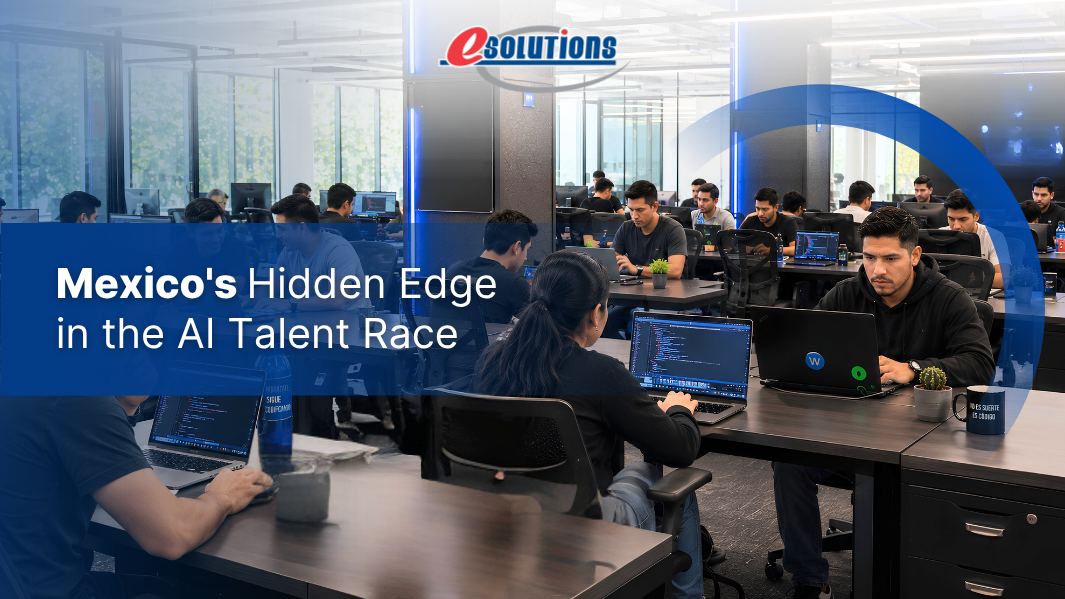
The AI Talent Race Is Creating New Hiring Challenges
Artificial intelligence is no longer an emerging technology but a business imperative. Across industries, organizations are investing heavily in AI-driven solutions to enhance productivity, accelerate innovation, and improve decision-making.
Mexico is rapidly emerging as a significant player in this transformation. The country's AI market reached $16.92 million in 2025 and is projected to grow to $180.05 million by 2033, representing an impressive 34.4% annual growth rate. AI adoption is accelerating across key industries, including finance, healthcare, logistics, and manufacturing, while Generative AI, Machine Learning, and Robotics continue to be the fastest-growing technology segments.
Global technology leaders are taking notice. Amazon, Microsoft, and Google have collectively committed more than $6.3 billion toward AI and cloud infrastructure investments in Mexico, reinforcing the country's growing importance within the global digital economy. Today, Mexico accounts for approximately 4.3% of the global AI market and ranks among the world's fastest-growing markets for AI adoption.
At the same time, workforce development is accelerating to meet evolving business demands. Generative AI learning enrollments have increased by more than 350%, while demand for AI and machine learning skills has surged since 2023. However, as AI adoption expands, competition for qualified talent is intensifying.
Organizations are increasingly competing for a limited pool of AI engineers, machine learning specialists, data scientists, and emerging AI-focused professionals. As a result, hiring cycles are becoming longer, talent acquisition costs are rising, and businesses are being forced to rethink traditional sourcing strategies.
This growing competition is prompting employers to look beyond conventional technology hubs in search of scalable, future-ready talent ecosystems.
As companies navigate the global race for AI expertise, one question is becoming increasingly relevant:
Could Mexico be one of the most strategically positioned AI talent markets for the next decade?
What Most Companies Overlook About Mexico's AI Talent Ecosystem
When organizations evaluate global markets for AI talent, attention often gravitates toward established technology hubs and highly competitive hiring centers. In the process, they may overlook markets that have quietly built the foundations required to support the next phase of AI-driven growth.
Mexico is one of them.
While widely recognized for its manufacturing strength and nearshoring advantages, Mexico has also emerged as one of the world's fastest-growing AI adoption markets. According to the QS World Future Skills Index 2025, AI usage in the country increased by 965%, placing Mexico among the top 10 globally for AI adoption pace. By late 2025, 66% of the population actively used AI technologies, exceeding the global average of 62%, while approximately 80% of Mexican businesses had already integrated AI into their operations, primarily through automation, virtual assistants, and customer service applications. Notably, nearly 30% of organizations are investing in training their own AI models, signaling a shift from AI consumption to AI development.
According to Statista, Mexico is home to approximately 220,000 software developers, making it one of Latin America's largest technology talent markets. The country's expanding ecosystem of engineers, developers, data professionals, and STEM graduates is increasingly contributing to software development, digital transformation initiatives, and AI-related projects.
Labor market trends further reinforce this momentum. According to PwC's AI Jobs Barometer, job postings in Generative AI-exposed occupations in Mexico increased by 84% between 2021 and 2024, reflecting growing employer demand for professionals capable of supporting AI-driven business strategies.
Mexico's geographic proximity to the United States, time-zone alignment, and established cross-border business infrastructure further strengthen its appeal. Organizations can often achieve real-time collaboration and operational integration while accessing a growing pool of technical talent in an increasingly competitive global hiring environment.
Where AI Growth Is Accelerating in Mexico
Generative AI has become one of the fastest-growing segments, reaching $257.5 million in 2025 and projected to exceed $1 billion by 2034. Organizations across finance, healthcare, and retail are increasingly leveraging Generative AI for content creation, customer service automation, and advanced data analysis.
Machine Learning represents the segment with the strongest long-term growth potential, forecast to grow at a 30.3% CAGR through 2034. Healthcare providers and healthtech companies are increasingly adopting machine learning to improve diagnostics, enhance decision-making, and support predictive patient care initiatives.
Meanwhile, AI-powered Robotics continues to gain traction within Mexico's manufacturing sector. Expected to reach $208.8 million by 2034, robotics adoption is being fueled by automation investments across major automotive hubs such as Coahuila and Guanajuato, where businesses are integrating AI-driven systems to improve operational efficiency and productivity.
Together, these developments highlight a broader trend: as AI adoption expands across industries and technologies, demand for specialized talent is growing just as rapidly.
The AI Talent Gap Is Becoming a Business Growth Challenge
As businesses move from isolated AI pilots to broader enterprise integration, many are discovering that technology investment alone is not enough. The ability to successfully deploy, manage, and scale AI initiatives increasingly depends on access to the right talent.
The challenge is that demand is growing faster than supply.
Across industries, organizations are increasingly encountering workforce bottlenecks as demand for machine learning, data science, AI engineering, automation, and other specialized capabilities continues to outpace available talent supply. At the same time, emerging AI-driven roles are creating workforce requirements that many businesses had not anticipated just a few years ago. As organizations pursue similar skill sets within a limited talent pool, securing the expertise needed to support AI initiatives is becoming progressively more challenging.
This competition is influencing both hiring timelines and workforce costs. Organizations are facing longer recruitment cycles as they search for specialized skill sets, while increasing demand continues to place upward pressure on compensation expectations. In highly competitive markets, securing qualified professionals has become increasingly difficult, particularly for businesses attempting to scale AI initiatives across multiple functions or locations.
The impact of this demand is also becoming increasingly visible in compensation trends across Mexico's technology workforce. As organizations compete for specialized expertise, skill premiums are emerging across enterprise software, cloud, and advanced digital roles. Recent market data highlight the premium being placed on these capabilities: SAP Consultants earn an average of MX$73,900 per month, followed by Google Cloud Engineers at MX$69,900, Azure specialists at MX$66,000, and Salesforce Consultants at MX$65,300. The growing demand for these roles reflects a broader shift within Mexico's technology ecosystem, where specialized expertise is becoming a key differentiator.
The implications extend far beyond recruitment challenges. Delays in securing specialized talent can slow AI implementation timelines, postpone innovation initiatives, and make it more difficult for organizations to translate technology investments into measurable business outcomes. In many cases, workforce constraints are becoming a factor that directly influences business agility and growth.
This is precisely why talent strategy is becoming a central component of AI strategy. Organizations can no longer afford to rely exclusively on conventional sourcing strategies when demand for AI-related capabilities continues to accelerate. Expanding access to emerging talent ecosystems is becoming an increasingly important consideration, and markets such as Mexico attract greater attention from companies seeking long-term workforce advantages.
AI Requires More Than Developers
When organizations discuss AI talent, the conversation often centers on software developers, data scientists, and machine learning engineers. While these roles remain critical, they represent only part of the workforce required to build, deploy, and maintain effective AI systems.
Companies are increasingly recognizing the importance of human-in-the-loop talent; professionals who help train, evaluate, refine, and improve AI outputs. These emerging roles are becoming essential to ensuring that AI systems deliver accurate, reliable, and contextually relevant results.
AI Trainers, for example, –
- help models learn from structured feedback and
- improve performance over time.
Prompt Specialists –
- work to optimize interactions with AI systems.
Human Feedback Experts –
- assess outputs and
- provide guidance that supports ongoing model improvement.
Similarly, Data Annotators –
- help prepare and label the information used to train AI models.
Model Evaluators –
- play a critical role in testing performance,
- identifying inconsistencies, and
- supporting quality assurance efforts.
The growing demand for these roles reflects an important reality: AI systems do not operate independently. They depend on continuous human oversight, refinement, and validation to remain effective in real-world business environments.
This trend is also reflected in Mexico's labor market. According to PwC's AI Jobs Barometer, both AI-augmented and AI-automated job postings experienced significant growth between 2021 and 2024, with average growth rates of 76% and 77%, respectively. The findings suggest that AI is not simply changing how work is performed; it creates demand for new skills and workforce capabilities across industries. The need for professionals who can work alongside, train, evaluate, and optimize AI systems is expected to continue growing.
For organizations scaling AI initiatives, this means talent requirements are becoming broader and more specialized. Success increasingly depends not only on accessing technical engineering expertise but also on building the diverse workforce capabilities needed to support AI throughout its lifecycle.
The Shift from Labor Arbitrage to Talent Arbitrage
For years, nearshoring conversations were largely driven by labor arbitrage - the ability to reduce operational costs while maintaining proximity to key markets. While cost efficiency remains an important consideration, it is no longer the primary factor shaping workforce decisions.
This shift is becoming increasingly evident in nearshoring strategies. A recent CI&T report found that more than three-quarters (76%) of technology leaders plan to increase nearshore hiring over the next two years, signaling a growing emphasis on talent access, collaboration, and workforce agility rather than cost reduction alone. As AI initiatives move from experimentation to execution, organizations are placing greater value on workforce ecosystems that can support speed, alignment, and real-time collaboration.
This evolution is giving rise to what many organizations now view as talent arbitrage: the ability to access specialized capabilities that may be difficult, costly, or time-consuming to source through traditional hiring markets. Rather than focusing exclusively on cost reduction, companies are seeking workforce ecosystems that can help them build competitive advantages through skills, expertise, and innovation capacity.
Mexico is increasingly emerging as a compelling example of this shift. The country is home to more than 910,000 technology professionals and produces over 110,000 new graduates annually, creating a sizable and continually expanding talent pipeline. At the same time, organizations can often access highly skilled AI talent at significantly lower costs than in the United States. For example, senior AI engineers in Mexico earn an average of approximately $7,400 per month, compared to around $19,000 for similar roles in the U.S., representing potential savings of up to 61% depending on the position.
The market's growing maturity further strengthens its appeal. More than 2 million businesses in Mexico have already adopted AI, reflecting increasing demand for AI-related expertise and a business environment that is actively integrating emerging technologies into day-to-day operations. This combination of workforce scale, AI adoption, and cost efficiency is helping reposition Mexico from a traditional nearshoring destination to a strategic AI talent hub.
Building AI Teams Requires Workforce Agility
Unlike traditional hiring needs, many AI projects evolve rapidly, requiring organizations to access specialized expertise at different stages of development, implementation, and optimization.
Some initiatives may require AI engineers and data scientists during the early stages of deployment. In contrast, others may depend on AI trainers, prompt specialists, model evaluators, or human feedback experts to improve performance and support ongoing refinement. As business priorities shift, workforce requirements often shift alongside them.
This poses a challenge for organizations that rely exclusively on conventional hiring models. Building AI capabilities is not always about filling permanent positions; it is often about accessing the right expertise at the right time. In many cases, organizations need the flexibility to scale teams up or down based on project demands, technology roadmaps, and evolving business objectives.
As a result, contingent talent, project-based specialists, and flexible workforce models are becoming increasingly important components of AI workforce strategies. These approaches can help organizations respond more quickly to changing skill requirements while maintaining access to specialized capabilities that may not be needed full-time.
For businesses navigating the evolving AI landscape, workforce agility is becoming a competitive advantage. The ability to access, deploy, and scale specialized talent efficiently may play an increasingly important role in determining how effectively organizations translate AI investments into business outcomes.
Turning AI Talent Access into a Competitive Advantage
As companies look beyond traditional hiring markets, Mexico offers access to a workforce that combines technical capabilities, geographic proximity, workforce scalability, and alignment with the evolving demands of AI-driven business environments. For organizations seeking to strengthen AI capabilities while maintaining workforce agility, these advantages are becoming difficult to ignore.
At E-Solutions, we have witnessed this shift firsthand.
- Through our experience supporting talent acquisition and workforce solutions across Mexico, we help organizations navigate complex hiring requirements, access specialized talent pools, and build scalable workforce strategies aligned with long-term business objectives.
- Whether supporting direct hiring initiatives, contingent workforce programs, or broader workforce management strategies, our focus remains the same: connecting businesses with the talent required to drive sustainable growth.
As organizations seek to strengthen AI capabilities and navigate increasingly complex talent markets, E-Solutions supports workforce growth through specialized talent acquisition, scalable hiring models, contingent workforce solutions, and workforce management expertise across Mexico. Our focus is not simply on filling roles but on helping businesses build workforce strategies capable of supporting long-term innovation, agility, and growth.
Works Cited
- CI&T. 2025. Tech Leaders Increase Nearshore Hiring as AI Reshapes Workforce Strategies.
- Dice. 2025. Latin America Emerges as a Key Hub for AI Talent.
- Interfell. 2026. How to Hire AI Trainers in LATAM: Complete 2026 Guide.
- Mexico Business News. 2025. AI Changed Tech Hiring Faster Than Companies Expected.
- PricewaterhouseCoopers (PwC). 2025. AI Jobs Barometer 2025: Mexico Analysis.
- Statista. 2025. Number of Software Developers in Latin America, by Country.
- QS. 2025. QS World Future Skills Index 2025.
- Coursera. 2025. Global Skills Report 2025.
- IMARC Group. 2025. Mexico Generative AI Market Report.
- IMARC Group. 2025. Mexico Machine Learning Market Report.
- Deep Market Insights. 2025. Mexico Robotics Market Outlook.
- Alcor. 2025. AI in Mexico: Market Trends, Talent, and Growth Opportunities.
- Alcor. 2025. Software Engineer Salaries in Mexico for 2025.
- Mexico Business News. 2025. General AI Adoption in Mexico Reaches 66%.
- Mexico Business News. 2025. AI Job Skills in Mexico Jump 148%.
- Georgetown University Center for Security and Emerging Technology (CSET). 2025. Funding the AI Cloud: Computing Investments.
- Mordor Intelligence. 2025. Mexico Artificial Intelligence Data Center Market.
- Startup Genome. 2025. Mexico City Ecosystem Report.
- IDC. 2025. The Intertwining Digital Economy.
- Grand View Research. 2025. Mexico Artificial Intelligence Market Outlook.
- PwC. 2024. Global AI Jobs Barometer.

 Facebook
 Twitter (X)
 WhatsApp
 LinkedIn
 Copy Link (Insta/Medium)

.png)